Saturday, April 21, 2018

Smyths Toys to buy Toys R Us in Germany, Austria and Switzerland By Mark Paul

Photo Credit: The Irish Times
Mayo family-owned retailing group will almost double in size, adding a further 90 stores to its network

Smyths Toys, the Mayo family-owned retailing group, will almost double in size after agreeing to a huge deal to buy rival, Toys R Us, in Germany, Austria and Switzerland. The deal will add a further 90 stores to the group’s network of 110 outlets which are located in Ireland and, mostly, the UK. Smyths, which already had group sales estimated at about €600 million, is now among the largest specialist toys retailers in Europe. Smyths is now targeting further European expansion. The Irish Times

Wednesday, April 18, 2018

Caruso - Luciano Pavarotti & Lucio Dalla

Photo Credit: Luciano Pavarotti & Lucio Dalla
www.apotis4stis5.com
Caruso

"Caruso" is a song written by Italian singer-songwriter Lucio Dalla in 1986. It is dedicated to Enrico Caruso, an Italian tenor. Following Lucio Dalla's death, the song entered the Italian Singles Chart, peaking at number two for two consecutive weeks. The single was also certified platinum by the Federation of the Italian Music Industry. Wikipedia

We're in Bloom

Japanese Cherry Tree

Tulips

Primroses


Forsythia

Magnolia

Wednesday, April 11, 2018

Austrian Max Hollein new head of New York's Met

Photo Credit: Deutsche Welle/Städel Museum
A year-long search for the next director of New York's Metropolitan Museum of Art has come to an end; Vienna-born art historian and former head of prestigious museums in Frankfurt, Max Hollein, has been chosen.

New York's Metropolitan Museum of Art announced Tuesday that it had named a new director. In August 2018, Max Hollein, originally from Austria, will take over the reins of the largest art museum in the US, with a collection of over 2 million artworks tracing 5,000 years of art history. Hollein currently serves as director and chief executive of the Fine Arts Museums of San Francisco, which comprises the de Young Museum and the Legion of Honor. Prior to that, he was director and CEO of three of Germany's most prestigious art institutions, including the Städel Museum, the Schirn Kunsthalle and the Liebieghaus, all in Frankfurt. 

A gifted leader
The Met noted in a press statement that Hollein had been elected at a meeting of the Board of Trustees as he "has demonstrated exceptional skill at building collections, diversifying audiences, and broadening institutional development." During his tenure at Frankfurt's Städel, the museum had notably doubled its exhibition space. At the same time, Hollein oversaw the development of digital strategies and evidenced an uncanny ability at managing exhibitions and collections of artworks spanning centuries, even millennia.

"Max is a gifted leader and is exceptionally well qualified to serve as our next director," said Dan Weiss, the Met's president and CEO. "I am confident that ours will be a strong and fruitful partnership, and that Max will help advance the Met's role as a global leader for culture and the arts."

An appointment during difficult times
Hollein's appointment is the first in 60 years that did not come from within the museum's internal ranks. The 10th person to occupy the Met's top post, Hollein succeeds Thomas Campbell, a British tapestries expert, who had been in the role since 2009. He enters the position in a difficult era; the Met, which has some seven million visitors each year, has had to cut costs and curb hiring after running a $10 million deficit during the 2016-17 fiscal year. Most recently, the museum made headlines for its decision to charge an admission fee for visitors from outside New York state. Previously, the museum's entrance fee was a suggested donation only. ct/eg (AFP, kna) DW-Deutsche Welle


Friday, April 6, 2018

What is Germany’s dual education system — and why do other countries want it?

Photo Credit: Deutsche Welle April 6, 2018
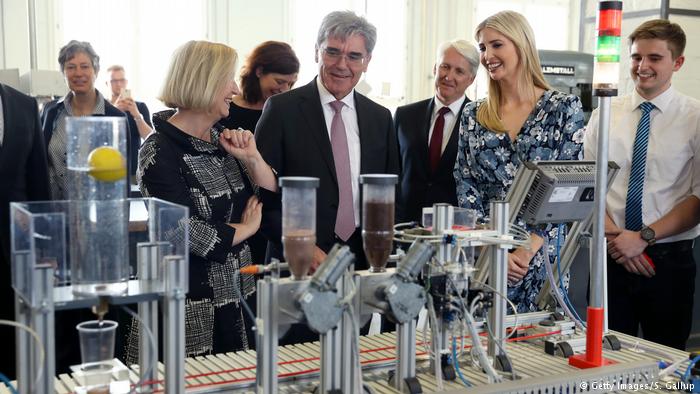
Getty Images/S. Gallup
The German economy is powered by products sold the world over. The strength of Europe's powerhouse depends on outbound shipments. We take a look at one of its latest exports and reveal the secrets behind its success. Charlotte Falke creates technical drawings of power plant generators. The 23-year-old designer, a trainee at German industrial giant Siemens, spent a year at university before opting for a more vocational program. "I left because there was too much theory," she said. "I wanted more practice." Falke is not alone. Over 50 percent of Germans enter dual vocational and educational training programs (VET) as a route into employment. They choose from 326 professional trades that include diamond cutters, aircraft mechanics and even chimney sweeps. The system is widely credited with fueling the German export engine. Outside the country, some tout it as a solution to rising youth unemployment. So how does VET work — and is it worth the hype?
Theory and practice
"The basic idea is duality," said Ralf Hermann, head of the German Office for International Cooperation in Vocational Education and Training (GOVET). "That means integrating school-based learning with work-based practice." Like most apprentices, Falke spends a few days a week at college learning foundation skills, such as math and language, as well as the theory underpinning her work. The rest of her time is spent mainly in the office designing products. The balance means she is able to produce technical drawings to industry standards and interact with her clients in English. "A broader education in school is necessary to provide the soft skills that make responsible young people," said Hermann, who points to the need for flexibility in a rapidly changing digital economy. "Occupations have a broader sense of skills than mere training for one particular job."
Outside interest
Vocational training exists in many countries, but such schemes are rarely as popular as in Germany. More young people follow VET programs than go to university, even though many are qualified for further study. Apprenticeships are standardized across the country — every product designer must study the same textbooks and be familiar with the same design tools — so employment prospects do not vary greatly by college or company. Most join their training company after three years of low-paid work and study. This is important for the German economy, which has one of the lowest youth unemployment rates in the EU, and also the largest trade surplus. In 2017 Germany exported €1.279 trillion ($1.571 trillion) worth of goods and imported €1.034 trillion. Some countries looking to balance their trade books are keen to learn from the German model. Ivanka Trump, adviser to protectionist US President Donald Trump, has expressed interest in bringing dual vocational training schemes to the US. Speaking to German weekly Wirtschaftswoche last year, Ms. Trump described Germany's apprenticeship system as "a great trailblazer." "The perception of our international partners is quite right," said Hermann. "Part of the economic stability in Germany is due to the core elements of the VET, in that we produce a workforce that is ready for the labor markets."
History of training
One reason for VET's success in Germany is a culture of apprenticeships that stretches back to the middle ages. The practical component of study is so pervasive in German education that many young people even opt for semi-vocational university courses. "This mixture you can't find in any other concept," said Marius Berger, a salesman at a German car manufacturer. The 27-year-old completed a dual study program in automotive retail, alternating 50/50 between three-month stints at university and internships at the company's headquarters. He graduated with a Bachelor's degree in 2012 and has stayed with the company since. "I searched for the possibility to combine my love for German cars with a good economic study program," said Berger. "For me it wasn't an option to do a normal Bachelor degree without any practical part." But feeding such systems into countries without a culture of vocational training poses problems. While Germany provides technical advice to countries looking to implement VET systems, such as Mexico and Russia, organizations such as GOVET are hesitant to describe vocational education as an export hit. "A system that has grown in Germany under very specific conditions cannot just be exported to another country under very different conditions," said Hermann. DW-Deutsche Welle

Tuesday, April 3, 2018

Friday, February 23, 2018

Michael Schulte to represent Germany at Eurovision Song Contest

A successful professional pop musician with a convincing rendition of a very intimate song: the northern German was the clear favorite at the country's national finals for the Eurovision Song Contest.

"Our Song for Lisbon" was the title of the show in Berlin on Thursday to decide which of six contenders would represent Germany at the 63rd Eurovision Song Contest on May 12. That song is "You Let Me Walk Alone" and is about the relationship of the 27-year-old northern German musician to his father, who died 13 years ago. The song goes through the head and up and down the spine at first listening, and one finds oneself wanting to hear it again.
Successful pop musician
Michael Schulte may still be unfamiliar to the television public, but he has 1.2 million Spotify listeners each month, and his YouTube channel is also very popular. Schulte has released seven albums and heads his own production company. After his triumph was announced, the singer, composer and producer was hugged by his competitors and the two hosts, television moderators Linda Zervakis and Elton. Schulte seemed to be pleased but not all that surprised at his victory. This year at Germany's national ESC final, three groups were equally represented in the decision-making process: an international jury, a panel of 100 ESC experts from Germany and viewers at home calling in their favorites. All three awarded the highest number – 12 points – to Schulte. DW-Deutsche Welle
Video